
Neuroqueer necropolitics: How regimes of power control and command how neurodivergent, queer and racialised subjects live or die (and What’s Neuro-Futuristic Love Got To Do With This)
by Kai Syng Tan
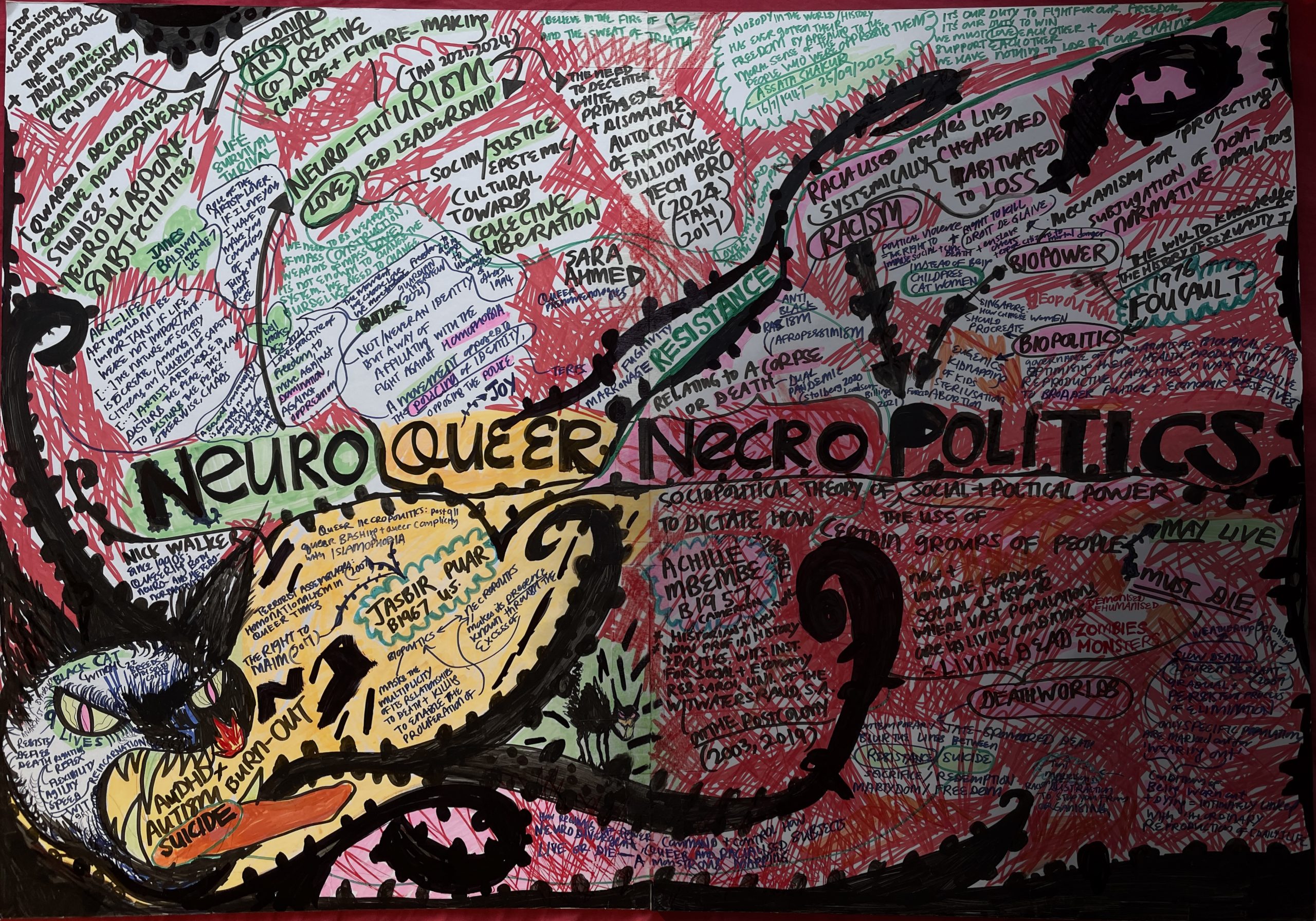
Neuroqueer necropolitics: How regimes of power control and command how neurodivergent, queer and racialised subjects live or die (and What’s Neuro-Futuristic Love Got To Do With This) is the long-winded title of my new monster-mapping.
There are two entangled components. Core of this is a busy, colourful diagram, with a range of texts and visual motifs. While I have drawn this using marker pens and highlighters on the back of two pre-used white-boards hastily stitched together with masking tape, I also added a shadow digitally on Photoshop on the far right, which tonally balances a large, dismembered head of a cat sticking out its tongue on the far left.
Working hand-in-hand with the diagram is this short critical text that you are reading.
As a multi-modal creative-critical research publication, this work introduces and explores “neuroqueer necropolitics” as a theoretical framework, technology and metaphor to identify, analyse and diagnose how normative, intersecting systems of power—including white supremacy, racism, colonialism, capitalism, classism, ableism, cisism, transphobia, heteronormativity and neuronormativity — (dis-)order the lives and deaths of subjects that are neurodivergent, queer, racialised and/or otherwised multiply-minoritised.
As a technology, neuroqueer necropolitics identifies and critiques the diagnostic, institutional, affective, and discursive mechanisms that pathologise, criminalise, and render certain bodies disposable.
As a metaphor, it operates in the spirit of Haritaworn, Kuntsman, and Posocco’s (2014) use of ‘queer necropolitics’ to illuminate the entanglements of vitality and disposability, inclusion and abandonment, as well as to provoke new ways of seeing, feeling, via mapping together the monstrous, the marginal, and the mis-fit.
As a theoretical framework, neuroqueer necropolitics is a monstrous, manifold, heuristic, pluralistic and promiscuous body of knowledge that draws (on), collates, collides and seeks to extend existing knowledges and traditions. They include: necropolitics, which theorises the subjugation of life to the power of death, especially underpinned by racism and colonialism (Mbembé and Meintjes, 2003; Mbembe, 2019) queer necropolitics and homonationalism, which expose how some queer subjects are ‘folded into life’ while others—especially racialised and non-normative bodies—are marked for abandonment or death (Puar, 2007); decolonial queerness, which calls for a planetary, intersectional praxis that resists the Eurocentric canon and centers the lived experiences and epistemologies of historically marginalised bodies (Bakshi, 2024), the ‘right to maim’, as a form of slow violence through strategic infliction of injury, incapacitation, and exploitation, as well as ‘debility’ as a third axis of state power alongside life and death (Puar, 2017) within regimes in which ‘Whiteness as a queer norm and straightness as a racial norm.” (Puar 2007).
To this mix, I introduce neurodivergence. Neuroqueer theory, which frames neurodivergence as both identity and resistance, queering normative cognitive, affective, and social expectations (Walker, 2015), is by now well-known. However, the point of mashing this with necropolitics is to highlight the need to disrupt and dismantle its white-supremacist and colonialist foundations. Neuroqueer necropolitics thus draws our attention to my calls since 2015 to make neurodiversity and disability discourse and practice diverse and divergent, away from the global north, racist, privileged, elitist centres (Tan, 2016; 2018) . It reinforces the messages and practices of many others before and near me for the need to temper discussions with more layered, intersectional approaches including scholars (Miles, Nishida and Forber-Pratt, 2017; Rashed, 2019; Barbarin, 2021; Piepxna-Samarasinha and Leah, 2022; Cheng et al., 2023; Page et al., 2023; Ahmadi et al., 2024; Jallow, 2024; Matshabane et al., 2024; Harrison and Mosen, 2025; Lewis and Arday, 2025; Nair, Vishnu KK, 2025; Nthibeli, Griffiths and Bekker, 2025; 2025; Rafique, Songo and Matshabane, 2025; Williams and Sobande, 2025; Nair, Farah and Boveda, 2026; Ventour-Griffiths, 2026; Jannesari, n.d.)and cultural workers (Ahsan, 2017; Butler, 2021; Mistry, 2021; Sen, 2021; Harriman, 2026; Harris, 2026; Shah, 2026; Sins Invalid, 2026; Joyce, n.d.). With neuroqueer necropolitics, I want to re-issue the warning that the fight against ableism and neuro-exclusion will fail if other oppressive habits and structures – trans-, Islamo- and other phobia – are reproduced (Tan, 2024a) – not least given the era of cock-shaped rockets and rage-baits ejaculated by billionaire Tech-bro cartoon tycoons and their autistic incel fanboys (Tan, 2024c), toxic autism politics of Trump’s second administration (Garcia, 2024) – and deadly regime of the new world (dis-)order.
Neuroqueer necropolitics isn’t just a mapping, but monster-mapping. Reclaiming ‘monstrosity’ as a form of resistance, monster-mappings are neuro-futuristic — a co-creative, neuroqueering, decolonial. Underpinned by Chinese Daoist epistemologies, these body-mind-world-maps (cor)relate and collide diverse and (neuro-)divergent themes/time/spaces/futures to enact “way-finding and re-direction during and beyond crisis” (Tan, 2024b). Mappings that are monstrous can mock and knock our ironic/moronic socio-political reality of monumental monstrosity, that arms and live-streams, 24/7, genocides that eradicate thekarama or dignity of even those previously rendered ‘perfect victims’ ; that oxygenates fake news and double-speak on un-ironically-named ‘Truth’ platforms; where TERFs, ‘white supremacy in black face’ (Abbey, 2024) politicians and other pound-shop foot soldiers that do the dirty jobs of patriarchal, racist and other oppressive regimes; where eugenicist and pro-natalist billionaire autistic tech-bros cannot stop colonising Mars with their cock-shaped rocket, or (re-)producing generative AI infrastructures that ejaculate cannibalistic hallucinations, and where EDI and DEI programmes – as have performative promises made during BLM 2020, have all but D-I-E-D.
Neuroqueer necropolitics links previously disconnected/ignored dots, and seeks to wake/shake us into joining up – literally and figuratively – through love, in order to kill killing, always in motion – and moving towards neuro-futuristic collective liberation.
This work extends a footnote tentacle to the Gothic, as an activist, care-led, creative-critical approach to research, practice and (re-)imagining that seeks to unsettle power dynamics within socio-political systems – which the academy is in bed with – via deliberate gestures of intellectual uncertainty, and moving towards a dangerous (re)search for knowledge, that builds on Jones (2009)and Henriksen et al (2022).
Indeed, Neuroqueer Necropolitics has another hidden subtitle, How the Academic Industrial Complex is Complicit with the Killing Machine, but I’ll save that one for another space.
Enjoy.
REFERENCES / FURTHER READING
Abbey, N., 2024. Tweet. [online] X (formerly Twitter). Available at: <https://x.com/nelsabbey/status/1852876140051857883> [Accessed 6 October 2025].
Ahmadi, Fariq, A., Hamdan, S. and Zuraida, Z., 2024. A CROSS-CULTURAL LENS ON NEURODIVERSITY: COMMUNITY PERCEPTIONS, STIGMA, AND SUPPORT SYSTEMS IN NON-WESTERN CONTEXTS. World Psychology, [online] 3(3), pp.484–501. https://doi.org/10.55849/wp.v3i3.1071.
Ahsan, H., 2017. Shy Radicals: The Anti-systemic Politics of the Introvert Militant: Hamja Ahsan.
Bakshi, S., 2024. Theorising Decolonial Queerness: Connections, Definitions, Articulations. In: L.M. Ben Fletcher-Watson and D. Osborne, eds. Essays on Decoloniality: Volume 1. [online] IASH. pp.35–56. Available at: <https://hal.science/hal-04519944> [Accessed 6 October 2025].
Barbarin, I., 2021. On today’s episode of “I Know Why That Happens:” Why are marginalized white people like that? https://t.co/GCxC2H7yMB. [Tweet] Twitter. Available at: <https://twitter.com/Imani_Barbarin/status/1404441612286152706> [Accessed 5 February 2023].
Butler, O.E., 2021. Positive Obsession. [online] Library of America. pp.725–31. Available at: <https://loa-shared.s3.amazonaws.com/static/pdf/Butler_Positive_Obsession.pdf> [Accessed 11 April 2023].
Cheng, Y., Tekola, B., Balasubramanian, A., Crane, L. and Leadbitter, K., 2023. Neurodiversity and community-led rights-based movements: Barriers and opportunities for global research partnerships. Autism, [online] 27(3), pp.573–577. https://doi.org/10.1177/13623613231159165.
Garcia, E., 2024. The toxic autism politics of Trump’s second administration. The Independent. [online] 12 Dec. Available at: <https://www.independent.co.uk/news/world/americas/us-politics/trump-toxic-autism-politics-b2659681.html> [Accessed 20 December 2024].
Harriman, M., 2026. Website. [online] Misan Harriman. Available at: <https://www.misanharriman.com> [Accessed 16 February 2026].
Harris, M., 2026. Website. [online] Marvel Harris Photography. Available at: <https://www.marvel-harris.com> [Accessed 16 February 2026].
Harrison, M. and Mosen, J., 2025. Global movements need global leadership: expanding neurodiversity-inclusive education beyond Western-centric perspectives in Southeast Asia. International Journal of Developmental Disabilities, [online] 71(6), pp.807–813. https://doi.org/10.1080/20473869.2025.2527252.
Henriksen, L., Kjær, K.M., Blønd, M., Cohn, M., Cakici, B., Douglas-Jones, R., Ferreira, P., Feshak, V., Gahoonia, S.K. and Sandbukt, S., 2022. Writing bodies and bodies of text: Thinking vulnerability through monsters. Gender, Work & Organization, [online] 29(2), pp.561–574. https://doi.org/10.1111/gwao.12782.
Jallow, L., 2024. White Supremacy’s Impact on Embracing Neurodiversity. Available at: <https://lovettejallow.com/neurodiversity/white-supremacy-impacts-neurodiversity/> [Accessed 9 February 2026].
Jannesari, S., n.d. Activist Projects. Available at: <https://www.sohailj.com/activist-projects/> [Accessed 9 February 2026].
Jones, T.G., 2009. The Canniness of the Gothic: Genre as Practice. Gothic Studies, [online] 11(1), pp.124–133. https://doi.org/10.7227/GS.11.1.12.
Joyce, J.V., n.d. Jacob V Joyce (@jacobvjoyce) • Instagram photos and videos. Available at: <https://www.instagram.com/jacobvjoyce/> [Accessed 12 November 2023].
Lewis, C.J. and Arday, J., 2025. We See Things They’ll Never See: Love, Hope, and Neurodiversity. Princeton University Press.
Matshabane, O.P., Hartford, A., Ewuoso, C.O., Palk, A.C., Koehly, L.M., Stein, D.J. and Vries, J. de, 2024. Advancing neuroethics in Africa. South African Journal of Science, [online] 120(5/6). https://doi.org/10.17159/sajs.2024/18180.
Mbembe, A., 2019. Necropolitics. Durham: Duke University Press Books.
Mbembé, J.-A. and Meintjes, L., 2003. Necropolitics. Public Culture, [online] 15(1), pp.11–40. Available at: <https://muse.jhu.edu/pub/4/article/39984> [Accessed 6 October 2025].
Miles, A.L., Nishida, A. and Forber-Pratt, A.J., 2017. An open letter to White disability studies and ableist institutions of higher education. Disability Studies Quarterly, [online] 37(3). https://doi.org/10.18061/dsq.v37i3.5997.
Mistry, A., 2021. DNR_RND: Reimagining the arts sector post-pandemic. [online] Disability Arts Online. Available at: <https://disabilityarts.online/collections/dnr_rnd-reimagining-the-arts-sector-post-pandemic/> [Accessed 20 July 2021].
Nair, Vishnu KK, 2025. Locating Neurodiversity: Beyond (White) Liberal Global Northern Conceptualisations. [online] Available at: <https://sheffield.ac.uk/ihuman/disability-matters/disability-matters-scholarship-collection/disability-geopolitical-south/locating-neurodiversity> [Accessed 9 February 2026].
Nair, V.K., Farah, W. and Boveda, M., 2026. Is neurodiversity a Global Northern White paradigm? Autism, [online] 30(2), pp.544–551. https://doi.org/10.1177/13623613241280835.
Nthibeli, M., Griffiths, D. and Bekker, T., 2025. Neurodiversity in South African Education. A Study of Policy and Research on Autism and Attention-Deficient/Hyper-Activity Disorder. Journal of Social Issues, [online] 81(4), p.e70031. https://doi.org/10.1111/josi.70031.
Page, A., Vira, A., Ledger, S., Mosen, J., Anderson, J., Charteris, J. and Boyle, C., 2023. Pacific inclusive education model: addressing dichotomies to ensure positive outcomes. Journal of Education Policy, [online] 38(5), pp.870–889. https://doi.org/10.1080/02680939.2022.2080275.
Piepxna-Samarasinha, L. and Leah, 2022. Future is Disabled, The: Prophecies, Love Notes and Mourning Songs. Vancouver: Arsenal Pulp Press.
Puar, J.K., 2007. Terrorist Assemblages: Homonationalism in Queer Times. Duke University Press.
Puar, J.K., 2017. The Right to Maim: Debility, Capacity, Disability. Durham: Duke University Press Books.
Rafique, M.A.C., Songo, B.S. and Matshabane, O.P., 2025. Moving with the drum beat of the community: Reflections on a decolonial and cross-cultural neuroethics community engagement (Imbizo) in Africa. In: Developments in Neuroethics and Bioethics. [online] Academic Press. pp.129–147. https://doi.org/10.1016/bs.dnb.2025.02.003.
Rashed, M.A., 2019. Madness and the demand for recognition: A philosophical inquiry into identity and mental health activism. New York, NY: OUP Oxford.
Sen, D., 2021. Dolly Sen – spanking reality arse since 2000. Available at: <https://dollysen.com/> [Accessed 10 August 2021].
Shah, R., 2026. Rajni Shah: performance-maker – writer – producer & curator. [online] Available at: <https://www.rajnishah.com/> [Accessed 16 February 2026].
Sins Invalid, 2026. Website. [online] Available at: <https://sinsinvalid.org/> [Accessed 9 February 2026].
Tan, K.S., 2016. (Dys)service Cat(Suit): ADHD, dyslexia and dyspraxia, conceptual artwork. Available at: <https://wellcomecollection.org/works/kkng8gjs> [Accessed 15 August 2020].
Tan, K.S., 2018. What else could ‘neurodiversity’ look like? Disability Arts Online. [online] 19 Feb. Available at: <http://disabilityarts.online/magazine/opinion/else-neurodiversity-look-like/> [Accessed 22 February 2018].
Tan, K.S., 2024a. Fighting ableism and neuro-exclusion will fail if other oppressive habits/structures (trans-, Islamo- & other phobia) are reproduced. Available at: <https://www.instagram.com/kaisyngtan/> [Accessed 15 June 2024].
Tan, K.S., 2024b. Neuro-Futurism and Re-Imagining Leadership: An A-Z Towards Collective Liberation. [online] Palgrave Macmillan. Available at: <https://kaisyngtan.com/artful/book-springer-nature/>.
Tan, K.S., 2024c. What’s love got to do with neurodiversity and HE art and design? Society for Research into Higher Education Blog. Available at: <https://srheblog.com/2024/11/29/whats-love-got-to-do-with-neurodiversity-and-he-art-and-design/> [Accessed 30 November 2024].
Ventour-Griffiths, T., 2026. Videos about Black history and more. [online] YouTube. Available at: <https://www.youtube.com/channel/UCLBeRp_xf9k_2rqJVKn6q5w> [Accessed 16 February 2026].
Walker, N., 2015. Neuroqueer: An Introduction. [online] Available at: <https://neurocosmopolitanism.com/neuroqueer-an-introduction/> [Accessed 20 December 2020].
Williams, J.N. and Sobande, F., 2025. Note to scene: Gender, race and rose-tinted nostalgia in emo. European Journal of Cultural Studies, [online] p.13675494251380627. https://doi.org/10.1177/13675494251380627.
BIOGRAPHY
Kai Syng Tan is an artist-academic-advisor-author-agitator. Tentacular and hyperactive they are a trans-disciplinary research innovator (including working on three books entangling creativity, futurity, anti-oppression, leadership with neuro-queering), creative practitioner (San Francisco International Film Festival Golden Gate Film Award; Biennale of Sydney), curator of programmes ranging £0-£4.8m (including the 75th Anniversary of the 5th Pan African Congress Celebrations to mark Black History Month that reached 18.2 million people worldwide, and the opening and closing ceremonies of Asia’s Paralympics praised as ‘game-changing’ by disability groups), and experienced academic developer and teacher (Principal Fellowship PFHEA, having taught in 200 universities worldwide), Firsts include: making Singapore’s first “political film” that was confiscated and banned (2001); being the first artist-in-residence at the Social, Genetic and Developmental Psychiatry Centre leading a project that then won a National Coordinating Centre for Public Engagement Culture Change Award (2018); being UK Adult ADHD Network’s first ever Creative and Cultural Consultant (2018-2023), and as the first creative researcher on an Editorial Board of the Royal College of Psychiatrists to help drive change on clinal education and training (2021-now). Their book Neuro-Futurism and Re-Imagining Leadership: An A-Z towards Collective Liberation (2024) introduces 26 love-led strategies to reframe ‘leadership’ as a trans- disciplinary, (co-)creative, diversified, decolonised, neuro-queered practice of change- and future-making. Networks founded includes the 480-member Neurodiversity In/& Creative Research Network. By day, Kai is Associate Professor in Arts and Cultural Leadership at the University of Southampton. Orcid: orcid.org/0000-0002-4491-7166; website: www.kaisyngtan.com/artful