On Gothic Practice
by The Internet Ghost Collective
Welcome to the special online supplement of a new special issue of Gothic Studies, on ‘Gothic Practice’!
You can access the whole issue on the Gothic Studies website. Read on for more information about ‘Gothic Practice’.
In a 2009 Gothic Studies article titled ‘The Canniness of the Gothic: Genre as Practice’, Timothy G. Jones suggests ‘Perhaps the Gothic is something that is done rather than something that simply is’.[1] Though Jones is not writing here about practice in an arts sense, his statement intrigued us, the members of the Internet Ghost Collective, who are the guest editors of this special issue. For some years now, we have worked with various practices, online and offline, to explore playful and creative aspects of the Gothic. With our proposal for this special issue, as we began looking for ways to turn these artistic practices into academic ones, Jones’s suggestion became a prompt we could use to invite others to rethink the Gothic with us. We have invited researchers, teachers, and artists to explore what a Gothic practice might be, how they themselves work in Gothic modes, and what happens when we imagine the Gothic not through what it is, but through what it does.
In art, practice ‘involves giving form to thought in a purposeful way that embodies meaning […] negotiated in many contexts’.[2] Graeme Sullivan illustrates the way that habit and intention collapse into practice through the example of the word ‘painting’:
The term ‘painting’ is both a noun and a verb. As a noun, there is ready acceptance that painting, as an object, has creative and material form, provenance, and a host of interpretive regimes through which it can be squeezed. However, when seen as a verb we get a sense of the way that painting as a practice is determined by the act of doing it. In this way, distinctions among terms such as painter, object, and viewer melt away as the circumstance or setting influences the meanings invoked in artistic efforts and encounters.[3]
Likewise, as a noun Gothic has one set of forms, provenances, and interpretive regimes, but through practice, we develop different shared languages and ways of imagining. What might we get out of the word ‘Gothic’ as a verb? And what might we gain by opening the space for Gothic Studies researchers to ‘think in a context’ or ‘think in a medium’ rather than thinking ‘in a language’? Sullivan suggests that while ‘the mind is the medium that most clearly shapes art practice, for many art researchers art materials are still the most tangible means that give form to imaginative thought. Therefore, when undertaking studio research where there is a focus on structural qualities among other interests, the artist really does think in a medium’.[4] What happens to our research when the Gothic is our medium? What are the aesthetics and materials and motions of this kind of practice? These are the questions taken up in this special issue on ‘Gothic Practice’.
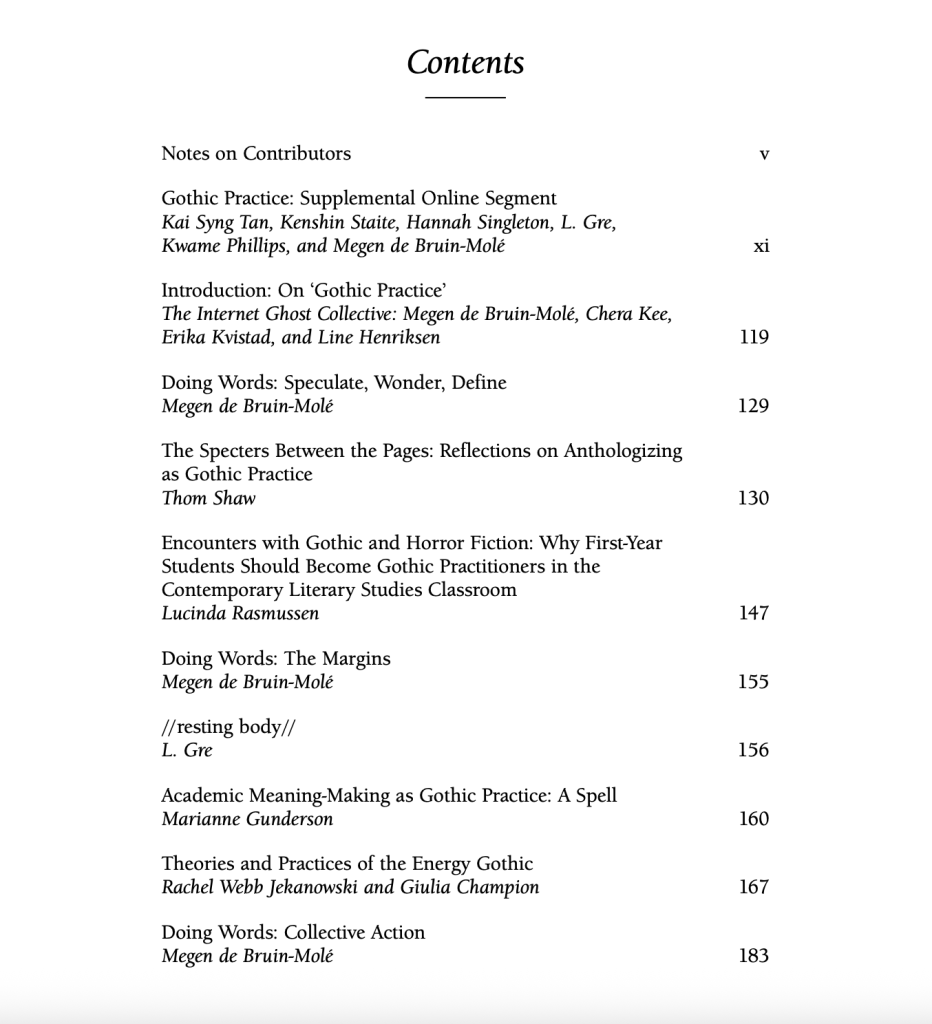
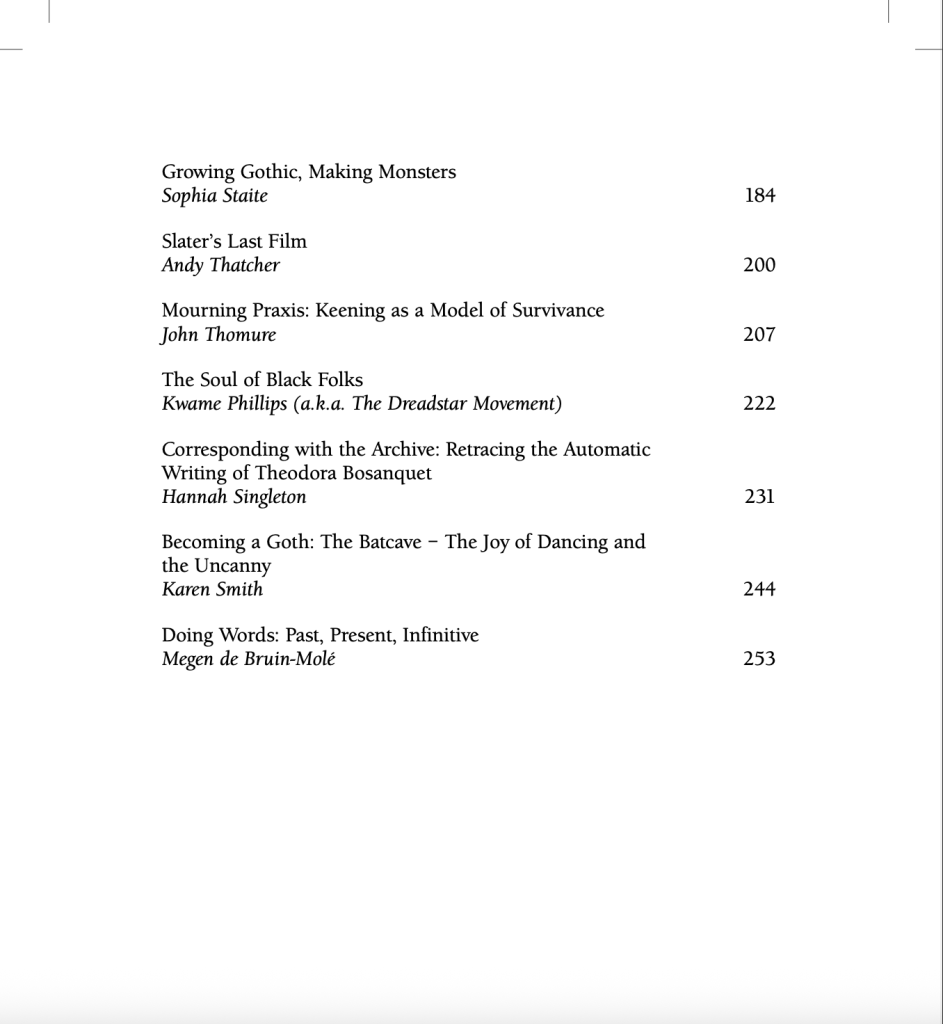
Through the links below you will find online-only supplemental material to the special issue. This includes:
🦇 Artworks by Kenshin Staite, which form part of Sophia Staite’s article ‘Growing Gothic, Making Monsters’. 🦇
🦇 An artwork and essay by Kai Syng Tan, ‘NEUROQUEER NECROPOLITICS: How Regimes of Power Control and Command How Neurodivergent, Queer and Racialised Subjects Live Or Die (and What’s Neuro-Futuristic Love Got to Do With This)’. 🦇
🦇 ‘The Soul of Black Folks,’ a work of mixtape research practice by Kwame Phillips a.k.a. The Dreadstar Movement. 🦇
🦇 A short video work by L. Gre, which forms part of their music and composition based research project //resting body//. 🦇
🦇 Images from an automatic writing archive by Hannah Singleton, drawing on her research into the practice and correspondence of Theodora Bosanquet. 🦇
🦇 ‘Doing Words,’ a series of photocopied collages by Megen de Bruin-Molé 🦇
Read more artistic and academic work by Thomas Leonard D. Shaw, Lucinda Rasmussen, Marianne Gunderson, Rachael Jekanowski and Giulia Champion, Sophia Staite, Andy Thatcher, John Thomure, Hannah Singleton, Karen Smith, L. Gre, and Kwame Phillips in the July 2026 special issue of Gothic Studies.
[1] Timothy Jones, ‘The Canniness of the Gothic: Genre as Practice’, Gothic Studies 11, no. 1 (2009): 124–33, https://doi.org/10.7227/GS.11.1.12, 127.
[2] Graeme Sullivan, ‘Research Acts in Art Practice’, Studies in Art Education 48, no. 1 (2006): 19–35, https://doi.org/10.1080/00393541.2006.11650497, 29.
[3] Sullivan, ‘Research Acts in Art Practice’, 30.