Dracula and why I fell in love with the Gothic

I cannot remember a time when I was not fascinated by the uncanny and the supernatural. Since childhood the macabre has had a strong pull over me. This was most firmly expressed when I was just seven years old and had my first encounter the Gothic.

Back in 2002, I can remember a time when one of the U.K.’s national newspapers had been giving away free books. Every week, readers were able to collect a classic literary tale to enjoy along with their daily newspaper. Already an avid reader, I saw this as the perfect opportunity to get my hands on such classics as Louisa May Alcott’s Little Women or Arthur Conan Doyle’s The Hound of the Baskervilles.

Having already collected and devoured several new novels, one week the novel on offer was Bram Stoker’s Dracula. Curious and eager to get my hands on a copy, I asked my mother to collect the book for me to read and was surprised as she replied with a resounding “No.” Having always been encouraged to read I was confused. When I pushed for an explanation all my mother had to say was “It’s too scary for you, you will have nightmares.” It was fair to say that that cryptic dismissal stayed with me well into adulthood.

Fast forward thirteen years and I crossed paths with the text again at university. Dracula was stalking the reading list of my third-year Gothic literature module, and I finally had the chance to visit Transylvania and meet the Count. It is an understatement to say that I was enthralled. I eagerly read chapter after chapter, desperate to find out if the heroes would prevail and drive out the vampire menace once and for all. The novel had a lasting impact, and it is one that I now try to revisit at least once per year.

Similarly, two years later I watched William Fredkin’s The Exorcist for the first time having long been warned against watching what many in my social circle had labelled ‘the scariest film of all time.’ Again, I was not disappointed, watching Reagan’s physical and mental transformation from innocent pre-teen to demonic monster was thrilling to behold. After the credits had rolled, I noticed a pattern between the most popular Gothic fiction and the notion that these stories were so scary that they became inaccessible, suited only to the bravest among us who are completely without fear.

For me then, as I am sure it is for many others, the Gothic has long been associated with the idea of the forbidden. A genre that holds within itself a fear so terrible that it is locked away until we are ready and even then, it may be too much for us to bear. Vampires, demons, werewolves, and a host of other monsters are waiting for us, ready to expose our deepest and darkest fears. As I grew older and came to enjoy more of the genre that started with Horace Walpole’s The Castle Otranto in 1764, I came to realise that it was not those surface level figures that had made the genre so popular. It is the subtext that dominates so many of the Gothic narratives that we enjoy that remain the source of their popularity. 

If we return to Dracula as an example, it is not just the idea of the blood-sucking vampire that terrified readers in 1897 nor has continued to do so ever since. Instead, the character is a vehicle for delivering a wide range of other far more tangible and salient fears that remain with us to this day. Dracula, crossing from his native Romania to metropolitan London, is both a disease and an immigrant, an uncontrolled and unchecked spread of biological matter and alien cultural beliefs. Two anxieties that are just a prevalent in the twenty-first century as they were when Stoker first published his work. Dracula is a layered and intricate work that demands to be reread. 

Indeed, this is another reason why I fell in love with the novel. Not all my previous revelations came to me after my first reading Dracula. It was only after two or three visits to the novel that much of this subtext and the text’s various connotations and implications made themselves present. Having read the novel more than once, I am continually amazed by its multiplicity. The Exorcist follows in the same vein; Reagan’s transformation is far more than a play on secular fears and the demonic. With its true terror being invoked by an intimate and chilling depiction of a fearsome and rebellious American youth that seeks to upset the natural order of the world.

Gothic fiction has had a long history of enthralling audiences, the combination of surface-level fears and wealth of subtext keep the genre alive. There is little doubt, given the world we live in, that there will be no shortage of cultural phenomena to keep the genre salient.

Looking to the future, novel and films such as The Exorcist and Dracula continue to have an endless appeal that shows no sign of waning. With the figure of the vampire in particular remaining a continued source of fascination to readers and audiences across the globe (the count himself received a BBC adaptation in early 2020), and the vampire being exposed to entirely new demographics thanks to the rise of the likes of Twilight and True Blood it appears that the vampire will continue to terrorise the public for years to come.

The Exorcist is also receiving a sequel in October 2023 and in doing so looks set to terrorise a whole new generation of audiences. The Gothic, then, appears to continue to go on. All one can do is hope that in another century a new generation of readers are just as drawn to the genre as I was those many years ago. 

—–

Connor Long-Johnson, currently writing his thesis on the fiction of Stephen King at the University of Greenwich in London, England, enjoys writing short stories in the gothic, fantasy and science-fiction genres. He has had various works published, three short pieces of fiction with HorrorTree’s Trembling With Fear, another in Breaking Rules Publishing’s horror anthology The Hollow and three with Science-Fiction website 365tomorrows. He can be found either at library or at cljohnson.co.uk.
OGOM Halloween Events

Throughout October, Open Graves, Open Minds have a series of seasonally spooky events to celebrate Halloween. See the full post for more details.

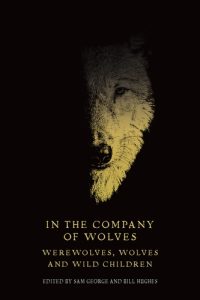
In the Company of Wolves: Werewolves, Wolves and Wild Children 2023

18.00–20.30 BST, 20 October 2023, online.

This event invites you into the company of wolves to listen to their voices as they sound in ‘our interpreted world’. You will be drawn into innovative research on the cultural significance of wolves, wild children and werewolves as portrayed in different media and genres.

In this evening of lively illustrated talks, we will situate the werewolf in a broader context of animality and sociality, challenging the simplistic model of the werewolf as the ‘beast within’, and embracing the werewolf as ‘spectre wolf’. Attendees can also take part in a challenge to redeem the wolf, join a discussion on wolves and lies based on Marcus Sedgwick’s essay on writing wolves and lies, and participate in werewolf flash fiction writing (40-50 words). We are launching the paperback edition of the OGOM Project book In the Company of Wolves which will be available at 30% discount to all our delegates.

Of all the Gothic monsters, the werewolf best expresses our ambivalent concerns with nature, both the natural world and our inner nature that is our animal heritage. This event is a chance to explore our own divided existence and the relationship of human beings to their environment. Wolves themselves are highly social and yet are portrayed culturally as monstrous predators; we look at the symbol of the wolf in various narratives. We look, too, at stories of wild children – often thought to have been raised by wolves – and what light they cast upon our emergence as linguistic, storytelling creatures from wild nature. 

Link to event https://www.opengravesopenminds.com/in-the-company-of-wolves-2003/

Booking via Eventbrite https://www.eventbrite.co.uk/e/in-the-company-of-wolves-werewolves-wolves-and-wild-children-2023-tickets-715491082087?aff=oddtdtcreator

Blog about event https://www.opengravesopenminds.com/ogom-news/in-the-company-of-wolves-werewolves-wolves-and-wild-children-out-in-paperback-augusts-2023/

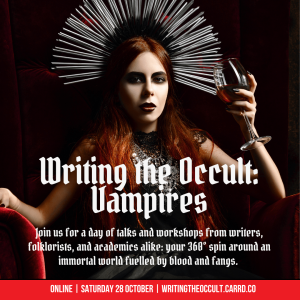
Writing the Occult: Vampires

Saturday 28th October, 1pm-9pm (UK time) online.

This event is for writers and readers in the vampire genre. It includes lively sessions by folklorists, writers and academics on such topics as making the vampire trope your own; vampire adaptations; the vampire as romantic lead; world-building for vampire tales; Gothic feminism; And more! Dr Sam George will be presenting on the folkloric vampire and its representation in fiction. The event is unique in featuring legendary writer Jewelle Gomez author of The Gilda Stories (1991). Gomez is celebrated this month in The Guardian as ‘the black lesbian writer who changed vampire fiction and the world’You can view the full programme and the speakers here https://writingtheoccult.carrd.co/

Booking via this Eventbrite page. Early bird tickets £40 (until 30th September). Regular tickets £45 (until 26 October).

Event on OGOM blog https://www.opengravesopenminds.com/events/writing-the-occult-vampires-28th-october-2023-online/

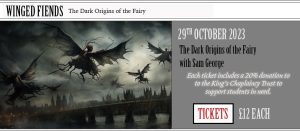
‘Winged Fiends: The Dark Origins of the Fairy’, Sam George 

29th October, Guy’s Hospital Chapel, London SE1

The event is part of the annual festival of arts entitled London Month of the Dead. This year’s grand calendar boasts a haunting array of over 60 talks, walks, workshops, and performances, each meticulously curated to ensnare hearts and minds alike. Placed throughout the hidden crevices of this ancient metropolis, you will be entertained by an enigmatic cadre of writers, artists, historians, experts, academics, practitioners, and performers—bearers of secrets and whispers from the shadowy depths.

Abstract

The prevalent innocent idea of fairyland is far from the shadowy realms of the dead, and yet there are many resemblances between them. Despite their wands and glitter, fairies have a dark history, and surprisingly gothic credentials. In The Secret Commonwealth of Elves, Fauns and Fairies (1682), fairy minister and folklorist Robert Kirk argued that fairies are ‘the dead’, or of ‘of a middle nature betwixt man and angels’This association is particularly prominent in Celtic lore. Writing in 1887, Lady Jane Wilde popularised the Irish belief that fairies are ‘fallen angels […] the devil gives to these knowledge and power and sends them on earth where they work much evil’.

It was widely believed in society at that time that fairies inhabited a shadowy spirit world. However, when Peter Pan debuted in the early 1900s with its prominent character of Tinker Bell, fairies began to lose their malevolence and became increasingly confined to the nursery. This is far from the notion of dark fairies with their shadowy history in folklore. Folkloric fairies steal children, drive people insane, blight cattle and crops – and drink human blood. Barrie, of course, was aware of their dark side. Despite the fairy dust and glamour, Tinker Bell is dangerous and vengeful like a deadly fairy temptress. At one point in the story, she even threatens to kill Wendy.

In folklore, fairies are often a demonic or undead force; one which humans need to seek protection against. As folklorist Katharine Briggs has noted in her Dictionary of Fairies. What is more, Fairyland has a hunger for human blood. This links fairies to the vengeful dead and to vampires. Diane Purkiss’s history of fairies, includes a Scottish Highland legend which warns that you must bring water into the house at night, so the fairies don’t quench their thirst with your blood. Very old fairies, like vampires, were said to wrinkle and dry up without fresh blood. The Baobhan Sith are vampiric Scottish fairies. These beautiful green banshees have hooves instead of feet, they dance with and exhaust their male victims then tear them to pieces. Like many fairies, they can be killed with iron. Dearg-Due are Irish vampiric fairies or “Red Blood Suckers”. They were thought to be influential on Sheridan Le Fanu’s female vampire tale Carmilla (1871).

Halloween is supposedly a time when the veil between our world and the shadow world is extremely thin. A time when encounters between humans and fairies are likely. This talk offers a warning to the curious, if you go seeking winged friends, they might not be as benevolent as you think!

More details: londonmonthofthedead.com/darkfairies.html

Festival of the Accused at British Library

Join Artist Amy Kingsmill as we explore reinventing and reclaiming the witch with Kirsty Logan, Juno Dawson, Malcolm Gaskill, Shahidha Bari, Marion Gibson, John Callow, Shami Chakrabarti, Marisa Carnesky, Ron Athey, Zoë Howe, the Witches of Scotland, Jenny Runacre, Parma Ham and more.

Photography – Rod Doyle

Full schedule and ticket info here.

The witch has long been a source of fear and revulsion but has become a symbol of feminine power, sexual liberty, indigenous knowledge and political rebellion.

The Festival of the Accused delves into the history of witchcraft and summons a host of writers and performers who praise and explore the witch. It tells the true stories of those accused in the English Witch Trials, a violent reckoning that gripped the country for hundreds of years and affected thousands.

It also celebrates modern devotees of the craft, in all their strangeness and subtlety. From the authors of ‘WitchLit’ telling tales of powerful covens, to queer performance artists who draw inspiration from the occult.

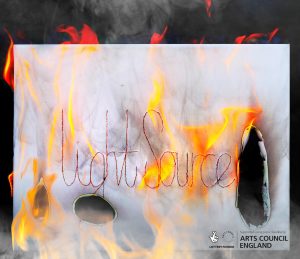
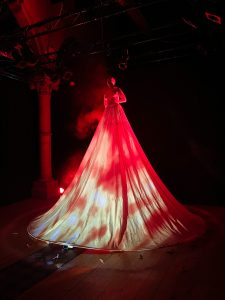
Light Source- Performance by Amy Kingsmill. Photo by Darren Black.

The festival concludes with a spectacular twilight performance by artist Amy Kingsmill and a memorial reading by actor Jenny Runacre in the Library’s open-air amphitheatre, the Poets Circle.

“I was born in Essex, deep in witch-hunter county and grew up learning about English history and its injustices. As a woman, I make work that addresses feminine trauma from a female viewpoint. This is a vital act. I don’t claim that I can heal thousands of long dead but hope that Light Source can give something back to these accused people; mothers, daughters, grandmothers, fathers, parents and siblings. This performance seeks to return their humanity and raise the importance of a national memorial for those unjustly persecuted.”  – Amy Kingsmill

I hope you can join us November 4th, for this monumental memorial day of discussions, reclamation and reckoning.

https://www.bl.uk/events/a-festival-of-the-accused-day-pass

My First Encounter with the Gothic: Krista Collier-Jarvis

My first encounter with the Gothic precedes my knowledge of the existence of Gothic itself. As such, it can be quite difficult to pinpoint exactly where that encounter manifested…

As a child, my memories of quality time with my mom were often in relation to horror films. On the weekends, we would curl up on the couch with snacks and watch the latest gorefest, such as the newest Halloween, a rerun of Pet Sematary, or a classic like Silver Bullet. It was not fear that I felt from these moments, but a kind of enjoyment within a safe space that shaped my understandings of “real-world” horrors versus how they are represented. 

My love of horror movies translated well in my English classes when we read short stories and novels that took up Gothic topics. I was drawn to the writings of Charlotte Perkins Gilman, Eudora Welty, and Edgar Allan Poe. My favorite Shakespeare play was Titus Andronicus (I couldn’t stop myself from researching the amount of blood used in the various adaptations). While not a Gothic text per se, Titus Andronicus felt like an Early Modern embodiment of the horror movies that shaped my childhood. I found myself drawn to reading and writing exclusively about the Gothic. I just didn’t know that what I encountered was Gothic.

The first time a professor named the genre as “Gothic” illuminated and reframed my relationship with those narratives.

When exploring options for my honours research, I initially met with Dr. Karen Macfarlane (MSVU). I was unsure what to focus on for a project of this length. She asked me what I thought I could talk about for a year, and I quickly responded with “The Walking Dead,” which I personally consider to be my first encounter with the Gothic. 

Discovering The Walking Dead

In high school, a close friend of mine was moving away. As a goodbye gift, he gave me my first comic books—the entire series of Lady Death: A Medieval Tale (2003). Yes, I resisted comic books during my childhood; I couldn’t possibly understand what the big deal was. I was immediately enthralled with the dark and beautiful artwork in Lady Death, with the representation of death as a powerful force, and with the serialisation of a story that kept me coming back for more. These stories were nuanced, complex reworkings of the very things I already adored in film and literature.

After completing the series, I felt hungry for more, so I visited the local comic book shop for the first time. I walked in the door and up to the first shelf and sitting front and center was the latest issue of the The Walking Dead; it was issue #9 (2004)—the one where Carl is accidentally shot by Otis. The cover made me uncomfortable with its peeling eye and oversized fly. I read through it so fast, enveloped by the story to the point where I didn’t even realise it was in black and white. I hunted down the first 8 back issues and thus my obsession began.

My honours research addressed the representation of pregnant women and newborns in The Walking Dead comics, and because the television adaptation was released partway through that year, I included some early scenes from the show. My Master’s thesis built upon this work; I looked at the little girl zombies in The Walking Dead as well as a host of other zombie narratives. I am now completing my PhD dissertation, and while I’ve turned away from The Walked Dead for the most part, I will most likely never be able to turn away from the Gothic. I’m hooked for life!

From trashy romance novellas to studying the uncanny: my first encounter with the Gothic

I’ve told this story before, I’m sure I have, but that’s the very nature of Gothic, isn’t it. It keeps coming back. My family background is an interesting mix of very down to earth farmers and people who cannot pass a bookshop without a purchase. There were always books in the house and I was always encouraged to read. To read for myself that is. For the longest time, I was quite upset that adults wouldn’t read to me until I fully understood reading myself also meant I was in control of what I read.

Nancy Schumann. Picture credit: soulstealer.co.uk

Full disclosure, I may not judge a book by its cover but I definitely pick books by their covers. It’s what happened when I had my first encounter with the Gothic. For some reason, my mother and grandmother went through a phase of reading romance novellas. You know the ones: women with great hair and bare-chested men on the cover, the content of the she meets him – he seems great – there’s an obstacle – there’s a happily ever after formula. In retrospect, this might have had something to do with the availability of books in the Easter Bloc. Those romance booklets could be brought across the Iron Curtain border without fear. Nobody was worried about them.

I didn’t go anywhere these booklets. Until, that is, I spotted one on my grandmother’s bedside table with a very dark cover: a ballerina in white watched by a cloaked man, almost hidden by a curtain. The title read: The Vampire and the Dancer. 

Well, I was having that one, thank you very much. Yes, it was a romance but it wasn’t Twilight-style. There was no happy ending, no ever after. There was a vampire, who like the Phantom of the Opera stalks the theatre where the ballerina dances. He has a whole lot of lived history to offer and the ballerina falls for him. They crash and burn for a fleeting moment in both their lives, walking away into lifelong yearning and an eternity of loneliness respectively. It was beautiful. Turns out what I need in a romance story is a tragic ending and we’re good. 

Vampires and their intrinsic potential to experience an eternity of lived history have been with me ever since, moving on to classics like Dracula and the amazing new takes on the myth like Sabella by Tanith Lee. So it was natural to continue my academic journey in the same direction and I made it my mission to shine a light as it were on vampiric women. 

I am forever fascinated by the subject that it continues to bring me joy. I watch with great delight as the vampiric works by women as well as female vampiric characters keep appearing and growing in works of fiction and there is so much more to explore. 

CFP: Anthropocene Gothic

Around three hundred years ago, the Industrial Revolution increased the print left by human activity on planet Earth. In 2000, Paul J. Crutzen and Eugene F. Stoermer, the well-known atmospheric scientists, coined the term “Anthropocene” as a geological designation associated with the perceived and quantifiable impact of humankind on the ecological functioning of the planet’s atmosphere.

Although the scientific community has not yet approved of an official re-naming of existing geological periods, the Anthropocene nomination has attained significant assent in ecocriticism, as well as in the specific trend within it which we now call EcoGothic which, according to Elizabeth Parker, is “a flavoured mode through which we can examine our darker, more complicated cultural representations of the nonhuman world ‒‒which are all the more relevant in times of ecological crisis” (Forest and EcoGothic).

Humankind has taken part in an insurmountable transformation of the planet that results from the ways we have used technology to mould Nature to our needs without considering a non-human perspective. However, when pandemics, earthquakes, hurricanes, and other natural disasters strike, we are forced to seclude our feeble bodies and witness our barricades and artificial strongholds collapse or barely keep us safe. During the last three centuries, Gothic narratives have reminded us that we are not in control when natural processes collide with our claim of superiority over the planet. 

For the present edited collection, with the provisional title Anthropocene Gothic, we invite contributors to submit articles that explore Anthropocenic perspectives and their multifarious presence in Gothic texts. Possible topics to explore might include, but are not limited to:

  • EcoGothic: Romantic vs Gothic approaches to the representations of the natural world
  • EcoHorror and the exploration of climate crisis anxieties
  • Plant horror: The monstrous vegetal in art
  • EcoGothic and Animal Studies
  • Donna Haraway’s concept of “companion species” and Anthropocene Gothic 
  • Horror of Contagion
  • Pandemics and its aftermath in Gothic literature and art. 
  • A dark ecology of the forest in Anthropocene Gothic.
  • Nautical Gothic and its relation to environmental concerns
  • Monsters and a blurring of the distinction between human and other-than-human in Gothic aesthetics 
  • Eco-disaster cinema
  • The Anthropocene perspective in Gothic: A dialogue with postcolonial and neocolonial studies 
  • The transformative potential of Anthropocene Gothic.

Please send a proposal of about 500 words, for chapters of 6000-7000 words, and a short biography to Aurora Piñeiro aurorapineiro@filos.unam.mx and Tony Alcala antonio.alcala@tec.mx by 30 November 2023.

Contributors can expect to be selected and notified by 15 December 2023. The deadline for submission of full articles will be 29 February 2024.

Gothic Travel through Haunted Landscapes: Climates of Fear

When we set out to write this book, we had in mind more than the preoccupation with travel that has marked the Gothic from its earliest moments. What caught our eye or, perhaps, our ear was the eerie footfall generated by Gothic journeys, as well as the power they possess to lead us into unfamiliar territory and to follow us home, dogging our steps wherever we go.

For fictional travellers, and for armchair tourists wishing they were ‘there’, Gothic landscapes have always generated turbulent imaginative atmospheres. As Devendra Varma claimed, the temper of the Gothic ‘spirit’ is that of fierce winds and storm clouds. Yet, from the later eighteenth century to the present moment, Gothic fiction has also captured physical geographies —awe-inspiring wilderness or unhomely local terrain – in vivid detail, conveying the challenges presented by topographical extremity and the elemental forces of more-than-human nature. 

Having spent perhaps too long in haunted houses, we wanted to venture outdoors into the open air, sharing the sensory and imaginative experience of walking through predominantly rural Gothic landscapes. Our book ventures far and wide: to both poles, Himalayan peaks, railway tracks in the Hudson valley, German forests and the Danube, as well to the wetlands and uplands, coastal fringes and secluded byways of the British and Irish Isles. Along the way, we trace uncanny stopping points, resting places, distractions and diversions that detain or disorientate Gothic travellers. Sometimes situating us at the edge geographically, these landscapes always place us on edge. The journeys we trace take different forms (recreational excursions, epic voyages, secular pilgrimages) and serve different purposes (escape, curiosity, self-improvement or transformative discovery), but whatever the motivation for those who travel, pleasure inescapably turns to fear. 

What we are thinking about here is encapsulated by the alliterative trio footfall, friction and frisson. In the narratives we survey, the physical impact of the human foot upon the ground triggers an echo, or activates an uncanny presence, that in turn generates a sensory response, a chill down the spine. Typically, such footfall is also peregrinatory, prone to wandering astray, at once immersed and adrift in estranging surroundings. These walkers become haunters and haunted, with Gothic travel representing a journey into error and terror. 

Of course, the most urgent footfall that haunts us is that of the Anthropocene, and our own damaging footprint. From the outset, Gothic has laid bare the human appetite for plunder and dramatized our vulnerability to the power of more-than-human nature. This awareness has often been expressed as muted but insidious anxiety about how we recklessly transform landscapes and devastate ecologies, but this concern tended to be moved offshore to far-flung or ‘peripheral’ places. Now, that distant dread is gradually creeping closer, stalking familiar routes. None of us can be vicarious travellers across this landscape, or tread too lightly. We have to look at the marks we leave, track the way we have come, contemplate where we are headed, and change the path we follow.

Gothic Travel through Haunted Landscapes: Climates of Fear, by Lucie Armitt & Scott Brewster. Published by Anthem Studies in Gothic Literature